Sugar Testing in Raw Cotton: An Overlooked Parameter That Defines Quality
Cotton is one of the most fundamental raw materials in the textile industry. However, just as important as its physical appearance, fiber length, or luster, there is another often overlooked parameter: residual reducing sugars.
Reducing sugars such as glucose and fructose may naturally exist in cotton fibers or increase due to harvesting and storage conditions. These compounds can cause undesirable effects during textile processing:
-
Color deviations during dyeing
-
Yellowing and oxidative degradation in non-scoured dyeing
-
Staining or burn marks during stenter processing
-
Stickiness and process instability inside machinery
Therefore, both raw cotton suppliers and dyeing/finishing mills must be aware of the sugar content in the cotton they process.
How to Use the Sugar Test?
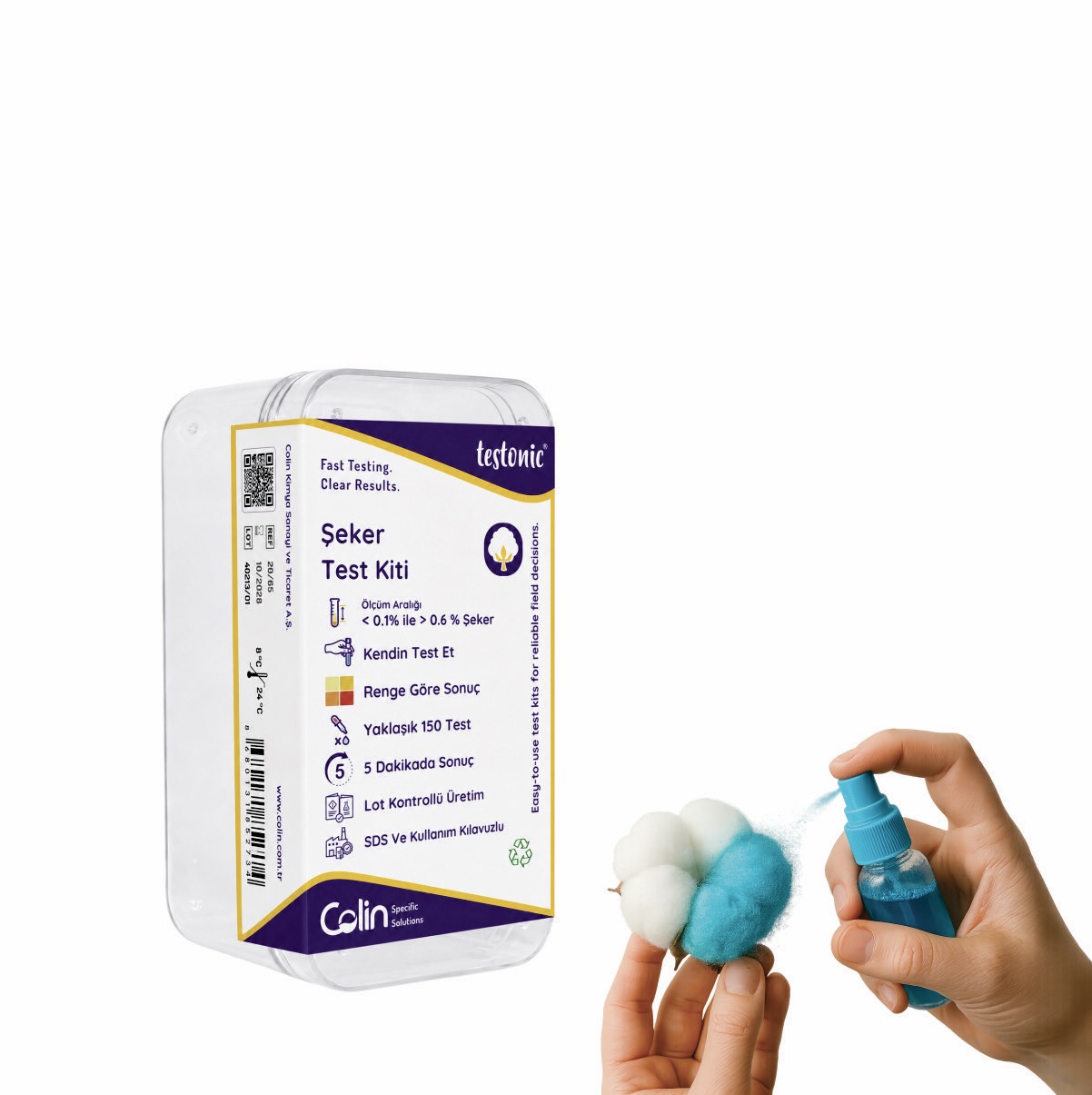
The Testonic Sugar Test Kit provides results through visually observable color change using a special indicator solution applied to the cotton fiber.
|
Color |
Sugar Level (g/kg) |
Description |
|---|---|---|
|
Light Blue |
0.0 – 0.2 |
Very clean cotton |
|
Greenish Blue |
0.3 – 0.6 |
Acceptable level |
|
Yellowish |
0.7 – 1.2 |
Moderate risk |
|
Orange |
1.3 – 2.0 |
High sugar – caution! |
|
Brown |
>2.0 |
Critical level – should be separated |
The test takes only 1–2 minutes and can be easily performed under field conditions.
Who Should Use This Test?
Cotton Blending Companies
-
Classify incoming cotton lots based on sugar content
-
Low-sugar cotton is preferred for high quality
Dyehouses and Finishing Plants
-
Processing fabric with high sugar levels unknowingly can lead to permanent defects such as yellowing
-
Preventative quality control can be implemented before shipment
How Are Sugar Residues Removed?
The most effective method for removing sugar residues is pre-dye scouring. In this process, natural residues such as sugar, pectin, and waxes are eliminated using alkaline solutions.
Fabrics with high sugar levels must be included in processes with proper scouring. Otherwise, problems such as color inconsistency and yellowing are inevitable.
Sugar Sources in Sizing Agents and Finishing Aids
Not only raw cotton but also some sizing agents and finishing chemicals may contain sugar-based ingredients:
-
Natural starch derivatives (e.g., corn or potato starch)
-
Modified polysaccharide-based sizes
-
CMC (carboxymethyl cellulose)
-
Dextrin and maltose-based formulations
Additionally, some softeners and polymer-based protective systems may contain sugar additives. These residues can also be detected with the Testonic Sugar Test and proper precautions can be taken.
Why Is It Important?
-
Ensures standardized quality continuity
-
Reduces raw material risk through input analysis
-
Minimizes complaints and return risks
-
Provides technical explanations and accountability distinctions for clients
In conclusion, sugar testing in cotton is not just an analysis—it’s a strategy for managing quality, cost, and brand value.
Quality in cotton starts with sugar control.
► Learn more: Sugar Test Kit - For Cotton