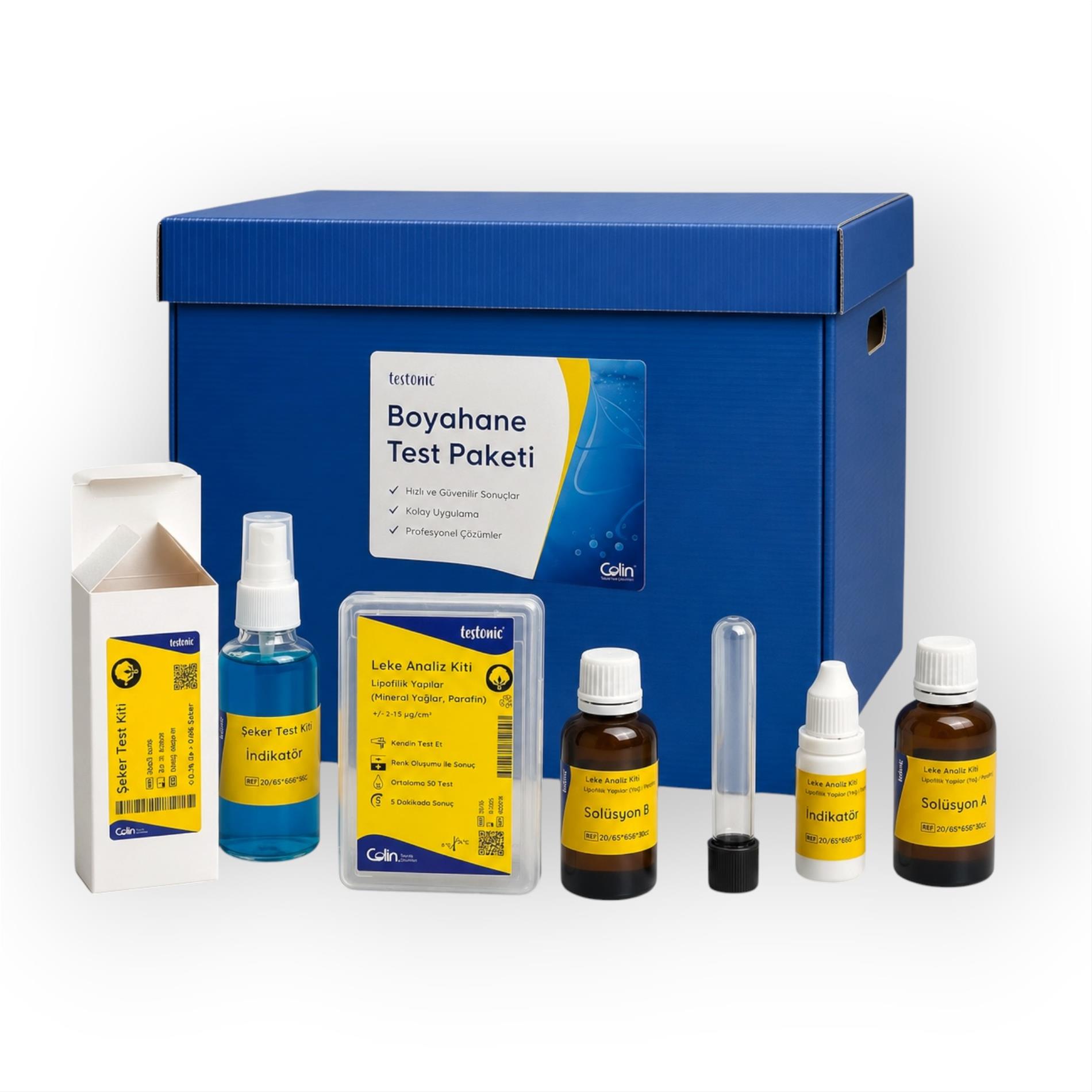
Part 1 - Water Quality – The Foundation of All Processes
Process water is the most fundamental input in finishing and dyeing processes. Ions, pH imbalances, and other impurities in water directly affect the performance of the chemicals used and can cause serious defects in the fabric.
|
|
Problem Encountered
|
Required Measurements and Test Kits / Necessity and Purpose of Use
|
|
Limescale stains, insufficient wetting, soap settling, dye agglomeration (clumping).
|
Total Hardness (Lime) Measurement:Total Hardness Test Kit (1 f)
Requirement: High water hardness reduces the effectiveness of dyes and auxiliary chemicals, causes a hard hold and stains on the fabric surface Purpose: To determine the need for water softening by measuring the total amount of dissolved Calcium (Ca²⁺) and Magnesium (Mg²⁺) ions in water in French (°f) or German (°d) hardness units.
|
|
Yellowing on fabric, rust stains, dullness or change in dye color, rapid deterioration of peroxide.
|
Iron (Fe²⁺/Fe³⁺) Measurement:Iron Test Kit
Requirement: Iron ions in water cause catalytic decomposition of peroxide, especially in bleaching baths, leading to inefficiency and fabric damage. In dyeing, it dulls colors and causes stains. Purpose: To determine the total iron ion concentration (ppm) in process water and take the necessary precautions (use of ion sequestrants, etc.).
|
|
Change in dye color tone, inefficiency in some dyes (metal complexes).
|
Copper (Cu²⁺) Measurement: Copper Test Kit
Requirement: Copper ions, like iron, can accelerate peroxide decomposition and react with metal-sensitive dyes, causing undesirable color changes. Purpose: To ensure dyeing and pretreatment processes by determining the copper ion concentration (ppm) in water.
|
|
Hole formation during the bleaching process, hardness and deposits in the fabric when using silicate-based stabilizers.
|
Silicate (Si⁴⁺) Measurement: Silicate Test Kit
Requirement: Water with high silicate content or incomplete rinsing of silicate-based stabilizers can cause glass-like deposits on the fabric surface and dye abrasion. Purpose: To eliminate the risk of deposits by measuring the amount of silicate in process water or rinse baths.
|
|
Inefficiency of chemical reactions and color deviations in all processes (bleaching, dyeing, washing).
|
Measurement of pH Value:pH Test Kit - Universal Indicator
Requirement: Every chemical process has an optimum pH range. A pH outside this range can cause chemicals to fail to work, dyes to fail to adhere, or fabric to be damaged. Purpose: To quickly check the pH of the process water, prepared baths, and the fabric after the process to keep the process within the correct range.
|
|
Conditions that affect the pH balance and can cause corrosion.
|
Alkalinity / Bicarbonate Measurement: Alkalinity Test Kit / Bicarbonate Test Kit
Requirement: Alkalinity, the ability of water to neutralize acid, determines how stable the pH will be. Uncontrolled alkalinity can shift the pH of dyeing and finishing baths in undesirable directions. Purpose: Control pH by measuring the total alkalinity or bicarbonate level of the water. to manage more precisely.
|
Section 2: Critical Controls in Pre-Treatment and Bleaching Processes
Pre-treatment is the most critical stage in preparing the fabric for dyeing. Errors at this stage can lead to difficult-to-repair problems in dyeing.
|
|
Problem Encountered
|
Required Measurement and Test Kit / Necessity and Purpose of Use
|
|
Abrasion (unevenness), smearing, inadequate hydrophilicity (water absorbency) in dyeing.
|
Sizing Residue Detection:Sizing Test Kit (Starch/PVA/PVAc/CMC/Acrylate)
Requirement: Sizing remaining on the fabric surface prevents dye penetration into the fiber, causing serious dye defects. Purpose: To check washing efficiency by determining whether and how many different types of sizing, such as starch, PVA, and CMC, remain in the fabric after the desizing process.
|
|
Stickiness, thread breaks, and dye unevenness due to raw cotton.
|
Detection of Sugar Presence in Cotton: Sugar Test Kit - For Cotton
Requirement: Natural sugars in raw cotton, storage and processing It can cause stickiness during bleaching and staining in subsequent processes (especially in dyeing). Purpose: To obtain preliminary information about the quality of the lot by quickly determining the sugar content in the raw cotton bale according to the color scale.
|
|
Insufficient whiteness after bleaching, fabric damage (low strength), color change during dyeing.
|
Hydrogen Peroxide (H₂O₂) Control:Hydrogen Peroxide (%) Test Kit / Hydrogen Peroxide Residue Test Kit in Bleaching
Requirement: The correct adjustment of the amount of peroxide in the bleaching bath is necessary for the degree of whiteness, and the absence of peroxide remaining in the fabric after the process is necessary to prevent color deterioration in reactive dyeing. is critical. Purpose: To measure the percentage of active H₂O₂ in the bleaching bath and the amount of peroxide remaining in the rinse water/fabric after bleaching.
|
|
Rapid depletion of peroxide in the bleaching bath, inefficient bleaching, formation of holes in the fabric.
|
Peroxide Stabilizer Analysis: Peroxide Stabilizer Structure Determination Test Kit
Requirement: Peroxide stabilizers provide controlled decomposition of H₂O₂. Wrong stabilizer selection or insufficient amount will cause the peroxide to decompose suddenly, making it ineffective and damaging the fabric. Purpose: Determine the silicate or organic-based structure of the stabilizer used to determine its compatibility with the process.
|
|
Odor and color differences in viscose fabrics after dyeing.
|
Sulfur Detection in Viscose: Sulfur Detection in Viscose Test Kit
Requirement: Sulfur Detection in Viscose fiber resulting from the production process Sulfur residues act as a reducer during dyeing, discoloring some dyes and causing unpleasant odors. Purpose: To prevent possible dyeing errors by detecting residual sulfur compounds in viscose fabric before dyeing.
|
Section 3: Troubleshooting in Dyeing and Washing Processes
This section covers dyeing and post-washing processes. The steps include tests to increase quality and efficiency.
|
|
Problem Encountered
|
Required Measurement and Test Kit / Necessity and Purpose of Use
|
|
Paint discoloration, stains, and inefficiency caused by hard water.
|
Ion Sequestering Performance Ömeasurement: Iron Binding Capacity Test Kit / Calcium Binding Capacity Test Kit / Copper Binding Capacity Test Kit
Requirement: Ion sequestering agents (sequestering agents) protect the dyeing process by binding hardness and metal ions in water. Low-performance or insufficient amounts of sequestering agents cannot fulfill their function. Purpose: To determine the effectiveness and correct dosage of the sequestering chemical used by measuring its iron, calcium, and copper binding capacity.
|
|
Fabric foaming after washing, insufficient hydrophilicity, and subsequent processing (finishing, etc.) problems.
|
Surfactant Residue: Surfactant Detection Test Kit - Anionicity / Surfactant Detection Test Kit - Cationicity / Surfactant Detection Test Kit - Nonionicity
Requirement: After washing and final rinsing, detergent, soap or softener residues remaining on the fabric, water may cause repellency (low hydrophilicity) and staining. Purpose: To detect whether there are anionic (soap/detergent), cationic (softener), or nonionic (wetting agent) surfactant residues in the rinse water or on the fabric.
|
|
Acid or alkali residue remaining on the fabric after dyeing, skin irritation, incompatibility with subsequent finishing processes.
|
Acid / Alkali Residue Detection: Chemical Residue (Acid/Alkali) Test Kit
Requirement: ÖAcid or alkali may remain in the fabric, especially in cases where the neutralization process is inadequate. This situation affects both the product's pH standard and may pose a risk to the user. Purpose: Quickly check the presence of acidic/alkaline residue in the final rinse water or on the fabric surface through color change.
|
|
Concentration uncertainty of acetic acid used in polyester dyeing or pH adjustment.
|
Acetic Acid Concentration: Acetic Acid % Percentage Test Kit
Requirement: The concentration of acetic acid used for pH adjustment in dye baths is important for recipe accuracy. The concentration of the supplied product may vary. Purpose: To quickly measure the percentage (%) of the incoming acetic acid solution or prepared bath titrimetrically.
|
|
Very dark colored or non-dyeable stains on the fabric surface, differences in matte or gloss.
|
Stain Analysis: Stain Analysis Kit – Polymer Structures (PVA, PVAc, Acrylate, CMC)
Necessity: Besides sizing, polymeric structures within chemicals such as creasing inhibitors, dispersion aids, or sequestrants can also accumulate on the fabric, forming a film and causing stains. Purpose: To determine whether a suspicious stain on the fabric is caused by film-forming polymers such as PVA or Acrylate and to identify the source of the problem (chemical, process, etc.).
Stain Analysis: Stain Analysis Kit – Lipophilic Structures (Oil / Paraffin)
Requirement: Lipophilic substances, such as spinning oils, paraffins, or machine oils, used in textile production processes can create permanent stains on fabric. These stains reduce the quality of the final product and lead to customer complaints. Purpose: This kit allows you to quickly and reliably determine whether a fabric stain is caused by lipophilic substances such as oil or paraffin. This way, you can identify the source of the stain and resolve the problem (chemical, machine, etc.).
Stain Analysis: Stain Analysis Kit – Silicone-Based Polymeric Structures
Necessity: In textile finishing processes, silicone-based softeners, especially those used to add touch, accumulate on the fabric, creating shiny, matte, or sticky stains.These stains can also negatively affect dye uptake. Purpose:To determine whether a suspicious stain on the fabric is caused by a silicone-based polymeric structure, thus enabling the identification of the chemical or process that caused the stain.
|
|
Insufficient water absorbency of the fabric, not absorbing finishing chemicals properly.
|
Hydrophilicity (Water Absorbency) Control : Hydrophilicity Test Solution
Requirement: Good hydrophilicity is essential for the fabric to absorb dyes and finishing agents homogeneously. Purpose: To quickly and visually evaluate the water absorption rate and capacity of the fabric with a colored solution.
|
|
Nickel from metal accessories (buttons, zippers) to the fabric contamination, risk of allergic reaction.
|
Nickel Detection: Nickel Test Kit
Requirement: ÖThe use of metal accessories containing nickel, especially in babies' and children's clothing, is restricted. It is important to perform this control during production. Purpose: To detect the presence of nickel on the surface of accessories such as metal buttons and zippers, or in process water.
|