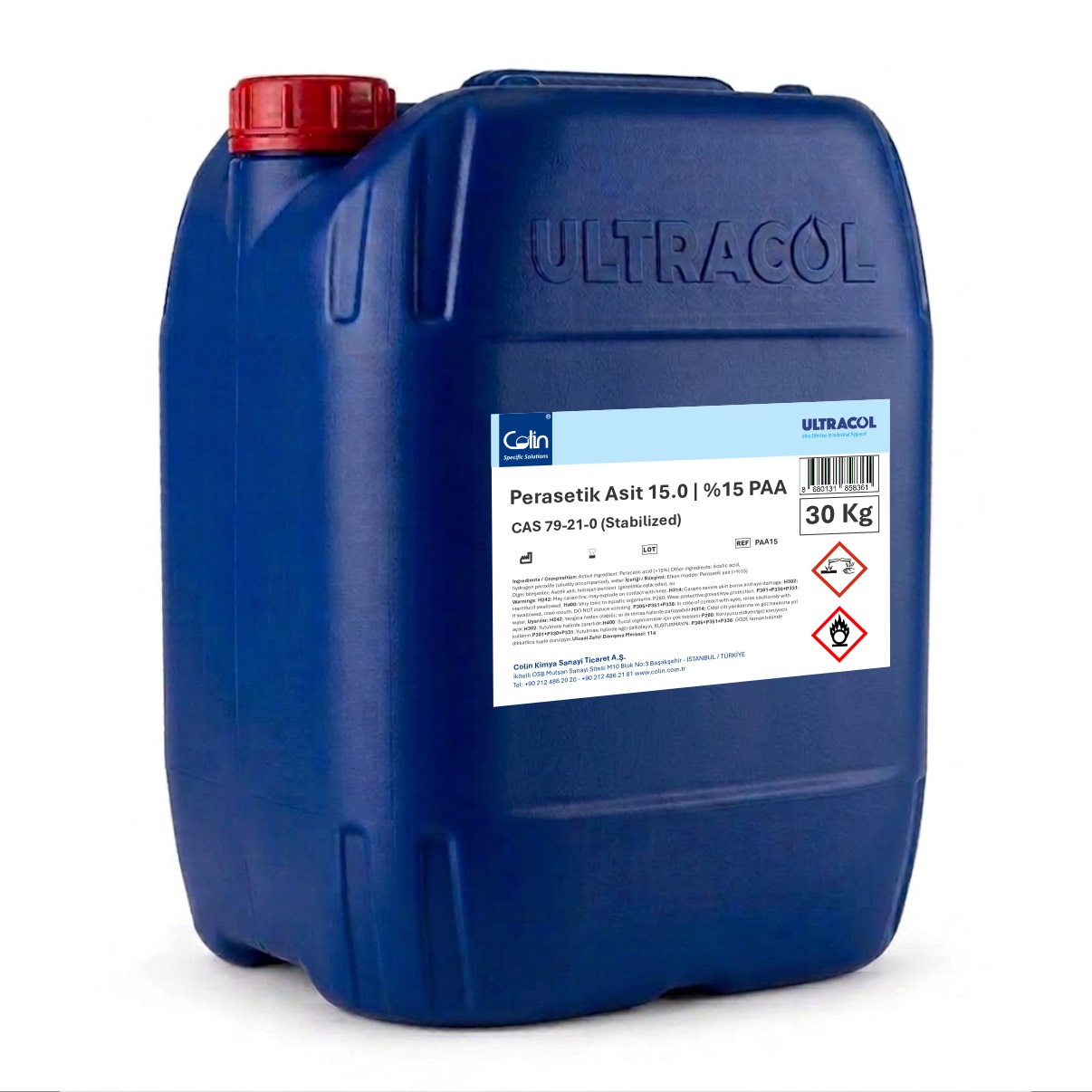
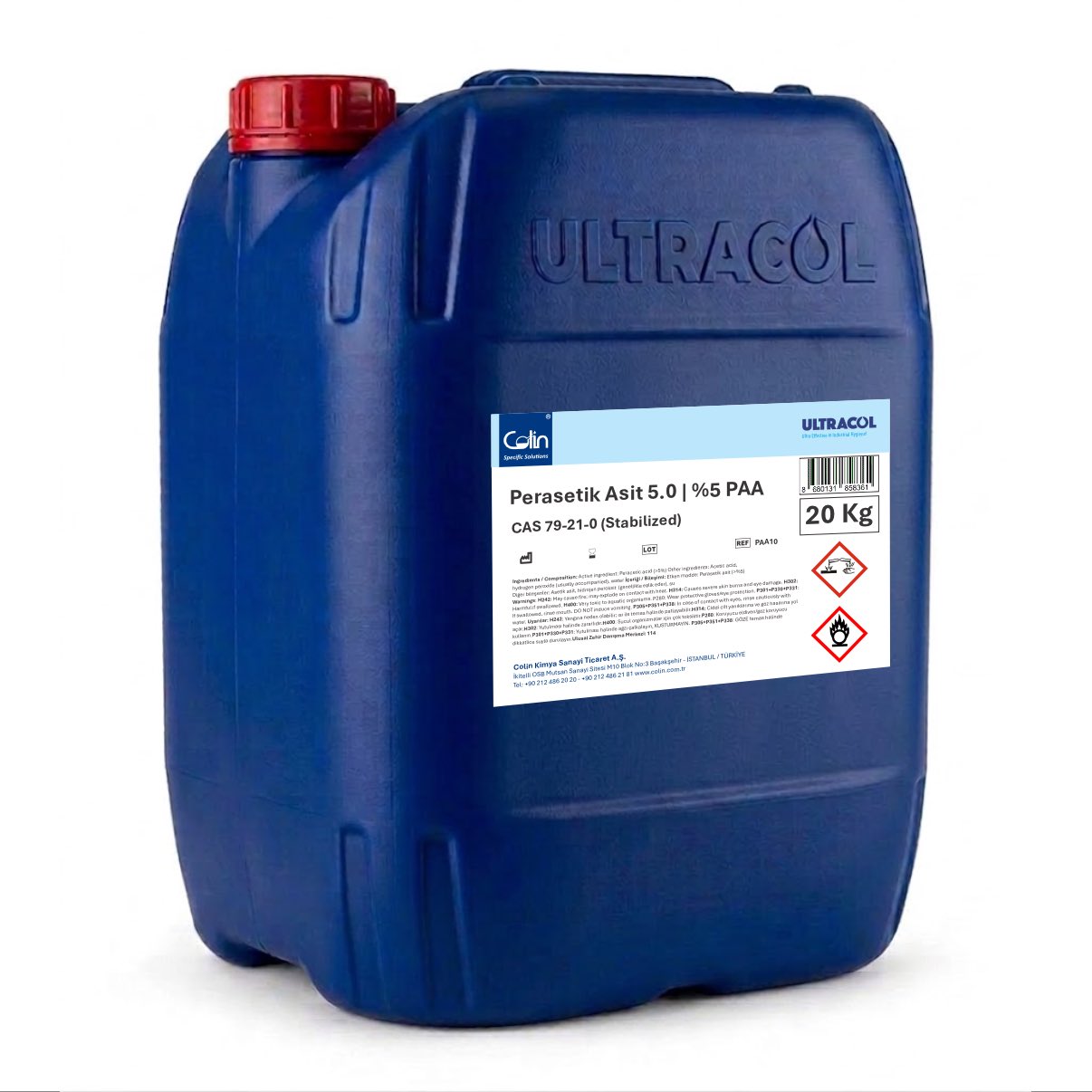
Peracetic acid (PAA) has become an essential tool in modern agriculture for controlling microbial load, biofilm formation, and irrigation system hygiene.
Developed by Colin Kimya, the Colin® PAA series provides greenhouse and citrus growers with a safe, residue-free, and environmentally compatible oxidative disinfectant that supports both plant health and production efficiency.
This article explains what PAA is, where and why it is used, and how to apply it effectively in different agricultural systems.
What Is Peracetic Acid (PAA)?
Peracetic acid is a powerful oxidizing compound derived from the reaction of acetic acid and hydrogen peroxide.
Unlike chlorine-based agents, it decomposes rapidly into water, oxygen, and acetic acid, leaving no harmful residues in the environment.
Its strong oxidative potential destroys bacteria, fungi, algae, and viruses and breaks down biofilm layers that clog irrigation lines.
In agriculture, PAA is valued for ensuring clean water systems, healthy root environments, and pathogen-free growing media.
Why Choose Colin® PAA?
Colin® PAA® products are specially formulated for agricultural and irrigation system use, offering high stability and consistent oxidative power.
Key Advantages:
-
Up to 10× higher oxidation potential than chlorine or quaternary ammonium compounds
-
Residue-free: breaks down completely into water and oxygen
-
Suppresses root pathogens such as Fusarium, Phytophthora, and Pythium
-
Removes biofilm and algae, preventing emitter blockages
-
Improves dissolved oxygen in the rhizosphere, enhancing plant vigor
-
Compatible with organic farming systems
-
Maintains activity over a wide pH range (5–7) and is UV stable
The Colin® PAA Product Range
| Product | Active PAA (%) | Application Area | Key Benefit |
|---|---|---|---|
| Colin® PAA 2.0 | 2% | Foliar & seedling applications | Safe for delicate tissues |
| Colin® PAA 5.0 | 5% | General greenhouse & irrigation use | Balanced and multipurpose |
| Colin® PAA 10.0 | 10% | Shock treatment, substrate disinfection | Strong oxidation, fast effect |
| Colin® PAA 15.0 | 15% | High organic load, end-of-season cleaning | Maximum efficacy, economic dose |
Where and Why Is It Used?
Greenhouse Applications
-
Continuous disinfection of irrigation water
-
Biofilm and algae control inside drip lines
-
Disinfection of soil, substrate, or hydroponic systems
-
Foliar disease suppression (Botrytis, mildew, leaf spots)
-
End-of-season structural and surface sanitization
Citrus Orchard Applications
-
Disinfection of open and buried drip irrigation systems
-
Sanitation of water storage tanks and reservoirs
-
Removal of algae and microbial deposits in emitters
-
Cleaning of harvesting tools, pruning shears, and crates
Recommended Concentrations and Dosages
| Application | Target PAA (ppm) | Product | Dose (mL/L) | Purpose |
|---|---|---|---|---|
| Continuous irrigation water | 5–20 ppm | Colin® PAA 5.0 | 0.1–0.4 | Microbial control, biofilm prevention |
| Shock cleaning / disinfection | 50–100 ppm | Colin® PAA 10.0–15.0 | 0.5–1.0 | Line flushing, heavy biofilm removal |
| Soil / substrate treatment | 200–400 ppm | Colin® PAA 5.0–10.0 | 2–4 | Root disease suppression |
| Foliar spray | 50–100 ppm | Colin® PAA 2.0 | 0.25–0.5 | Prevent Botrytis, mildew, leaf blight |
| Equipment / surfaces | 0.1–0.5% (1000–5000 ppm) | Colin® PAA 10.0–15.0 | 1–5 | Disinfection, no rinse required |
Always verify concentration with Merck® or Testonic® PAA test strips.
How to Apply
-
Inject directly into the irrigation system via a dosing pump.
-
Maintain pH between 5.0–7.0 for optimal performance.
-
Ensure a 15–30 minute contact time in the system.
-
For continuous maintenance, keep PAA at 5–10 ppm.
-
Apply foliar sprays during cool hours, as a fine mist, avoiding direct sunlight.
Example Use Cases
Greenhouse (Tomato, Cucumber, Pepper):
-
Every 15 days: 200 mL Colin® PAA 5.0 per 1000 L water
-
End of season: 1 L Colin® PAA 10.0 per 1000 L for line disinfection
Citrus Orchard (Orange, Mandarin, Lemon):
-
Every 15 days: 300 mL Colin® PAA 5.0 per 1000 L irrigation water
-
Water tanks: maintain ~50 ppm PAA for constant disinfection
-
If emitters clog with algae: 100 ppm Colin® PAA 10.0, hold 2 hours, then flush
Safety & Environmental Responsibility
-
Wear gloves, mask, and goggles during handling.
-
Avoid prolonged contact with metals (use stainless steel, HDPE, PTFE).
-
Store in a cool, shaded, and ventilated area.
-
Fully biodegradable: decomposes into water and oxygen.
-
Suitable for sustainable and organic production systems.
Conclusion
Colin® PAA is a next-generation oxidative disinfectant that ensures sustainable water hygiene, disease control, and biofilm management in both greenhouses and citrus orchards.
By applying the correct concentration and frequency, growers can achieve higher yields, cleaner irrigation systems, and healthier plants.
“Safe oxidation is the foundation of healthy production.”