In modern industrial hygiene and disinfection processes, the demand for solutions that offer both high efficacy and environmental compatibility is greater than ever. Peracetic acid (PAA) stands out as a powerful and eco-friendly biocidal agent that perfectly meets this need. Thanks to its strong oxidizing properties, PAA demonstrates broad-spectrum efficacy against bacteria, viruses, fungi, and even the most resistant spores, offering a revolutionary alternative to traditional disinfectants.
This compound, formed from a mixture of organic acids and hydrogen peroxide, rapidly decomposes after use into harmless and non-toxic byproducts (acetic acid, water, and oxygen). This characteristic makes it indispensable in critical areas where residue is undesirable, such as food processing, medical equipment sterilization, agricultural sanitation, and water treatment.
As Colin Kimya A.Ş., we are proud to offer a range of PAA solutions, developed with years of experience and formulated with stabilizers for a long shelf life, in various concentrations for industrial use. In this guide, we will examine each product in our range in detail, sharing their general applications, dilution methods, and practical recommendations for safe use.
Why Choose Peracetic Acid?
Peracetic acid offers many technical and environmental advantages over traditional chlorine-based disinfectants:
-
Broad Spectrum and Fast Action: Provides over 99.9% efficacy against all known groups of microorganisms, even with very short contact times ranging from 30 seconds to 10 minutes.
-
Eco-Friendly and Residue-Free: Does not form harmful residues or chlorinated byproducts (like Trihalomethanes - THMs) after use. It biodegrades rapidly in nature.
-
High Performance at Low Temperatures: Maintains its effectiveness even in cold CIP systems or applications with cold water, providing energy savings.
-
No-Rinse Formulation: Especially in the food and beverage industry, at certain concentrations (e.g., 80-150 ppm), it does not require rinsing on food-contact surfaces, saving water and time (Must be checked according to local regulations).
-
Organic Load Tolerance: Maintains its effectiveness better than many other disinfectants even in the presence of organic soil (blood, protein, milk residue, etc.).
-
Low Corrosion Effect: When used at the correct concentration and contact time, its corrosive effect on stainless steel (304, 316) surfaces is much lower than that of chlorinated compounds.
The Colin Kimya PAA Product Line: A Detailed User Guide
Below, you will find the specially designed applications, dilution calculations, and practical tips for each of our products. Remember, %1 PAA = 10.000 ppm (mg/L).
1. PERACETIC ACID 2000 (2000 mg/L or 0.2% PAA)
General Description:
Formulated as a low-concentration, safe-contact surface disinfectant. It provides oxidative cleaning without residue in food, agriculture, and drinking water systems.
Featured Application: High-Level Disinfection (HLD)
This concentration is also ideal for high-level disinfection and partial sterilization of medical and laboratory equipment. It plays a critical role in hospital infection control (HAI) for endoscopy units, surgical instruments, and dental equipment. It effectively removes protein-based contaminants (blood, mucus).
Scientific Basis:
-
Shows 99.99% efficacy in the 400-1500 ppm range against resistant spore-forming pathogens like Clostridium difficile.
-
It is a preferred concentration in FDA-approved automated endoscope reprocessors (12 minutes at 50-56°C) and shortens processing time.
Applications and Recommendations
|
Application Area |
Dilution Ratio |
Method of Use |
|---|---|---|
|
Agriculture – Irrigation systems, greenhouses, drip lines |
Directly or diluted 1:1 with water. |
Dosed into the system water to achieve 50–100 mg/L active PAA for biofilm and algae removal from lines. |
|
Food sector – Fruit, vegetable, egg surfaces |
1:20 |
The product is prepared to contain 100 mg/L active PAA. Rinse after 2–5 min contact. |
|
Kitchen and catering equipment |
1:10 – 1:20 |
Surfaces are rinsed after 1–2 min contact. |
|
Hospital and medical surfaces (non-critical areas) |
1:10 |
Applied via a one-step wipe method, no rinse required. |
|
Cooling towers, air washer systems |
1:5 |
Provides 10–20 mg/L active PAA according to the microbial load of the circulating water. |
2. PERACETIC ACID 2.0 (2% or 20,000 ppm PAA)
General Description:
A multi-purpose disinfectant solution with medium-level oxidative power. It can be safely used in food production areas (dairy, meat products) and on medical surfaces.
Featured Application: Food Industry Sanitation
Suitable for the disinfection of countertops, cutting boards, CIP systems, pipelines, and packaging equipment. Elevates hygiene standards.
Scientific Basis:
-
According to the EN-13697 standard, a 150 ppm concentration provides adequate protection against dangerous foodborne pathogens like Listeria monocytogenes.
-
Practical Example: When used in equipment washing at a dairy plant (1:100 dilution, target 200 ppm), it has been observed to reduce the microbial load by 4 logs (i.e., 10,000-fold).
Applications and Recommendations
|
Application Area |
Dilution Ratio |
Method of Use |
|---|---|---|
|
Food – Filling lines, CIP systems |
1:100 – 1:200 |
Circulate for 5–10 min to achieve 100 ppm PAA before the final rinse. |
|
Agriculture – Greenhouses, seedling trays, equipment disinfection |
1:50 |
Applied by spraying or dipping; no rinse required after drying. |
|
Medical – Instrument pre-cleaning (non-invasive) |
1:20 – 1:40 |
Rinse with purified water after 10 min contact. |
|
Hotels, restaurants, catering surfaces |
1:100 |
Wiping or spraying for floors, sinks, counters, and cutting areas. |
|
Drinking water systems and tanks |
1:500 |
Dosed to achieve 4 mg/L PAA, rinse after 30 min contact. |
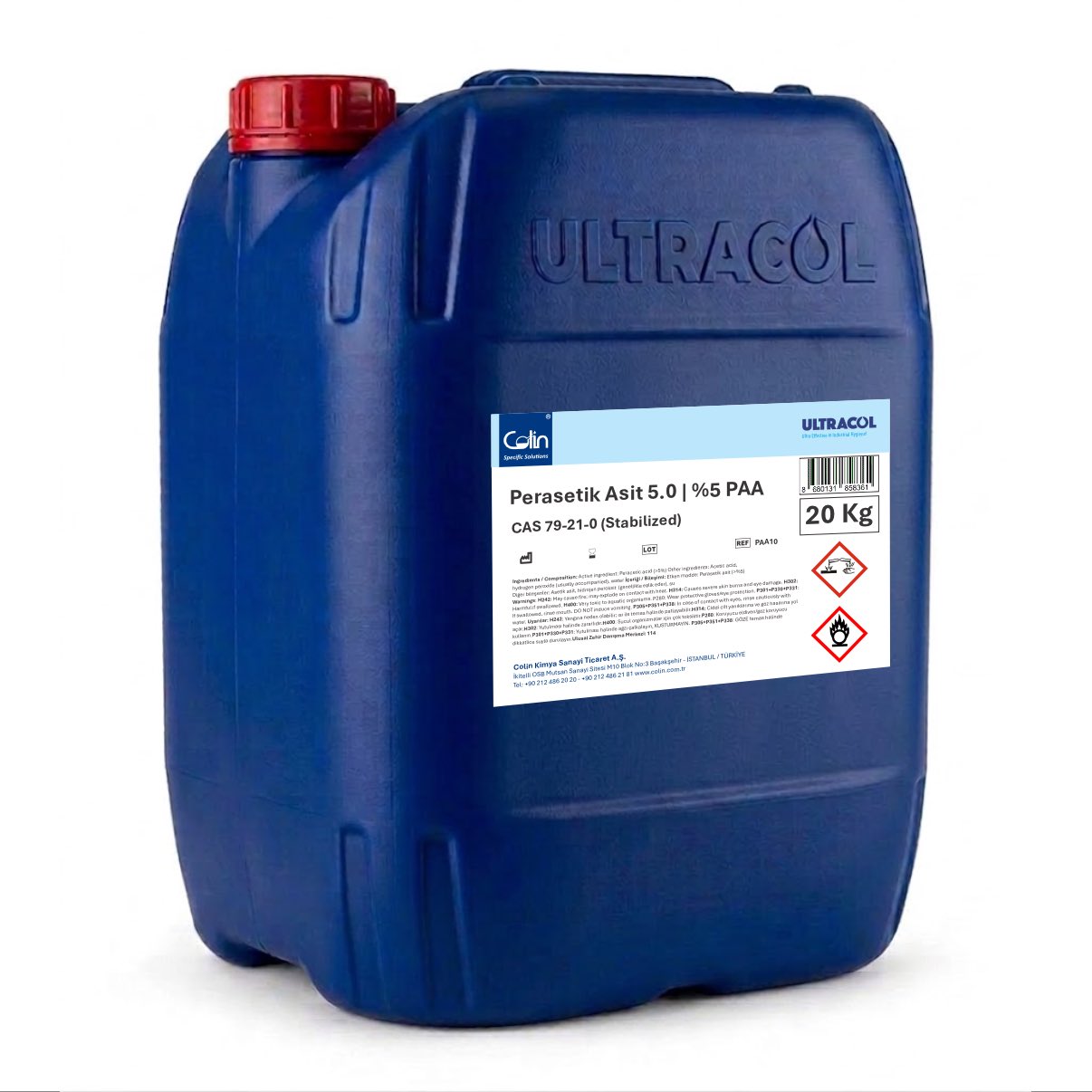
3. PERACETIC ACID 5.0 (5% or 50,000 ppm PAA)
General Description:
A high-efficacy, broad-spectrum disinfectant for industrial and agricultural use. Provides rapid oxidative action against bacteria, yeast, mold, and viruses.
Featured Application: Post-Harvest Agriculture
Ideal for the surface disinfection of lettuce, fruits, and vegetables. Ensures water hygiene and algae control in hydroponic and aquaponic systems.
Scientific Basis:
-
A 1-2 minute wash at 40-80 ppm concentration shows 99.9% efficacy against E. coli and Salmonella and does not require a rinse.
-
Practical Example: When applied in apple washing at a fruit processing plant (1:625 dilution, target 80 ppm), it has been reported to extend shelf life by up to 20%.
-
It is USDA-approved and suitable for use in organic farming.
Applications and Recommendations
|
Application Area |
Dilution Ratio |
Method of Use |
|---|---|---|
|
Food industry – CIP, filling, tank and pipe disinfection |
1:200 – 1:500 |
Circulate for 10 min to achieve 80–250 ppm active PAA, rinse. |
|
Agriculture – Drip irrigation, greenhouses, seedling disinfection |
1:100 – 1:200 |
Spraying or systemic flushing. Rinse after 20–30 min waiting period. |
|
Medical – Instrument and surface disinfection |
1:40 – 1:100 |
5 min contact time, then rinse with purified water. |
|
Non-food industry – Bottling, dairy, and beverage plants |
1:300 |
Targets 150 ppm active PAA in automated CIP systems. |
|
Hotels, kitchens, laundries |
1:200 |
Rinse after cleaning surfaces and equipment. |
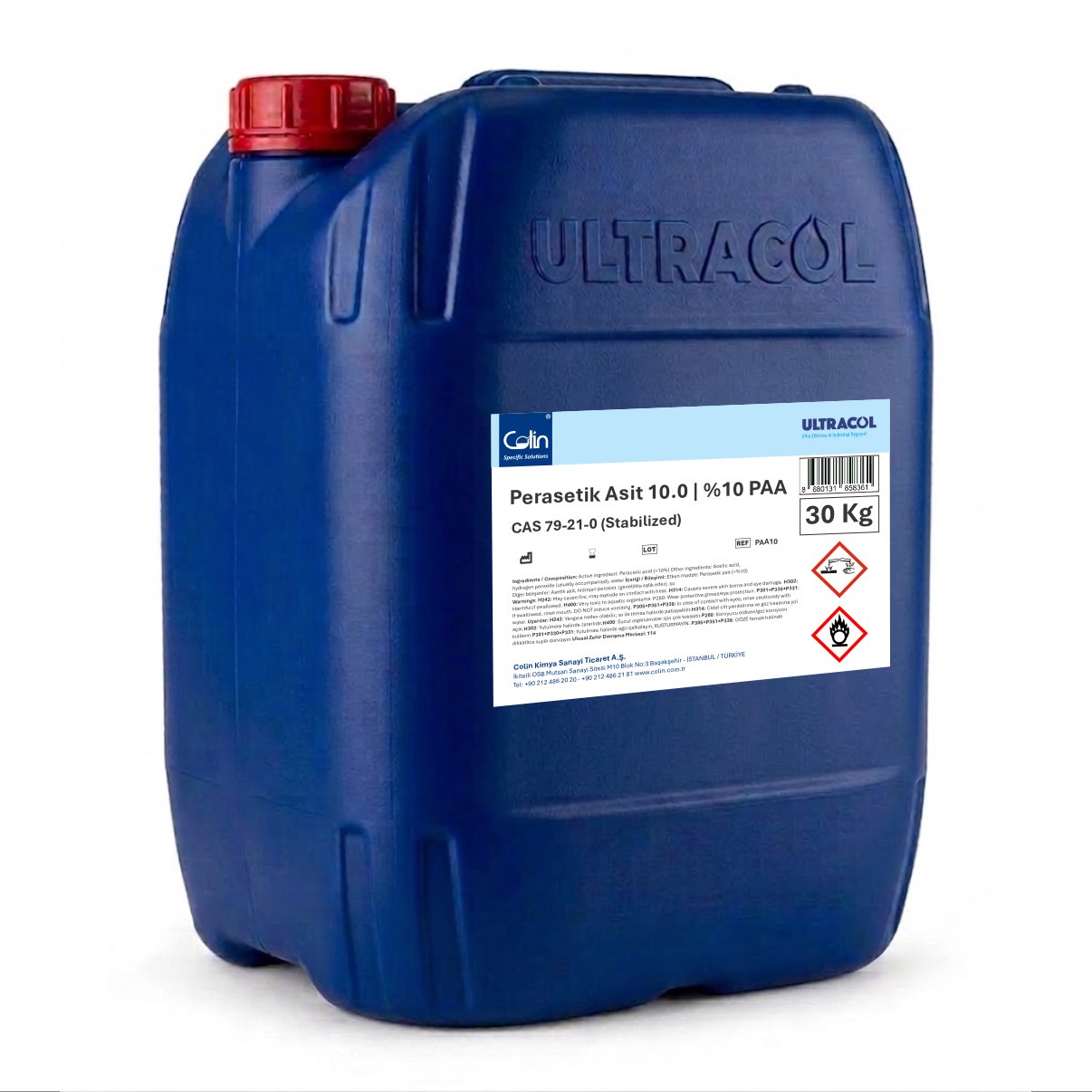
4. PERACETIC ACID 10.0 (10% or 100,000 ppm PAA)
General Description:
Developed for industrial systems, filling lines, and environments with high organic loads that require intensive disinfection.
Featured Application: Water Treatment and Wastewater
Ideal for drinking water, swimming pools, industrial wastewater, and fish farms. Unlike chlorine, it does not form harmful trihalomethane (THM) byproducts.
Scientific Basis:
-
A strong alternative to chlorine according to EPA standards. A 30-minute contact time at 0.7-2 ppm is effective against fecal coliforms and chlorine-resistant parasites like Cryptosporidium.
-
Practical Example: When used instead of chlorine in a wastewater treatment plant, it reduces disinfection costs by up to 15% and provides an eco-friendly discharge.
Applications and Recommendations
|
Application Area |
Dilution Ratio |
Method of Use |
|---|---|---|
|
Industrial – Food, dairy, beverage production lines |
1:400 – 1:800 |
Circulate for 10–15 min in CIP system to provide 125–250 ppm PAA. |
|
Agriculture – Disinfection of floors, plastics, and trays in greenhouses |
1:200 |
Spraying or dipping. Wait for drying after application. |
|
Medical – High-risk surface disinfection (e.g., laboratories) |
1:50 |
10 min contact time, then rinse thoroughly with water. |
|
Cooling towers, wastewater lines |
1:1000 – 1:2000 |
Biofilm control is achieved with continuous dosing. (Can be diluted up to 1:50,000). |
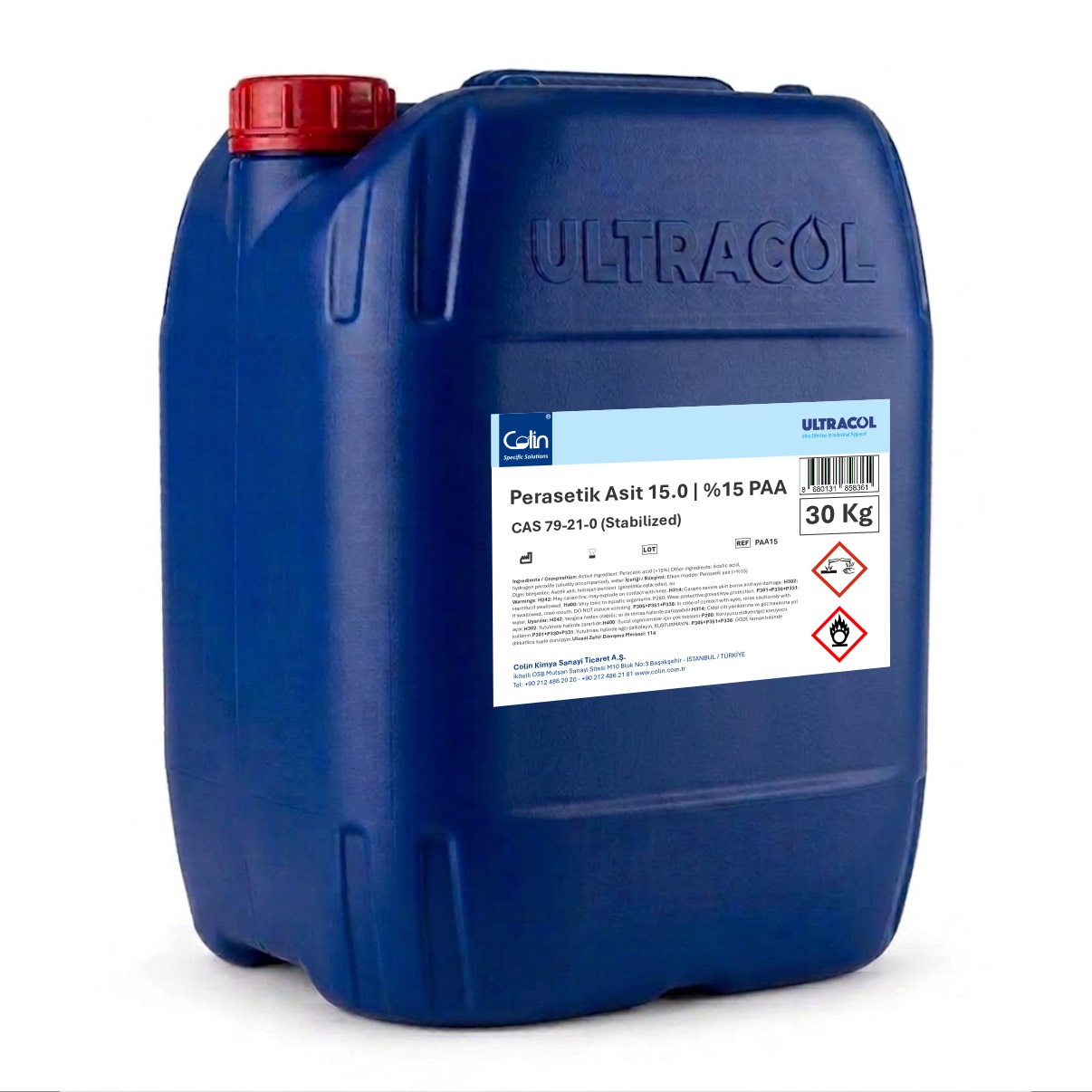
5. PERACETIC ACID 15.0 (15% or 150,000 ppm PAA)
General Description:
The professional and industrial concentration grade. It offers the most economical dilution rate. Due to its strong oxidant structure, it is used in systems with heavy soil and microbial loads, in aseptic packaging, and in chemical synthesis processes.
Featured Application: Industrial General Disinfection
Suitable for factory floors, machine equipment, and chemical oxidation and bleaching applications.
Scientific Basis:
-
Practical Example: When used for floor disinfection in a chemical factory (1:300 dilution, target 500 ppm), it extends equipment life by reducing the corrosion risk caused by chlorine.
-
It is one of the primary chemicals of choice for packaging sterilization in aseptic packaging lines (e.g., Tetra Pak).
Applications and Recommendations
|
Application Area |
Dilution Ratio |
Method of Use |
|---|---|---|
|
Industrial CIP systems |
1:800 – 1:1000 |
Provides 150–200 ppm active PAA. Rinse after 10–15 min contact. |
|
Wastewater, cooling towers, membrane systems |
1:1000 – 1:2000 |
Continuous dosing at 5–10 mg/L PAA level. |
|
Agriculture – Systems with high microbial load (e.g., post-harvest equipment) |
1:300 |
10 min contact time. |
|
Hospitals and laboratories – Biosafety areas |
1:50 – 1:100 |
10 min contact, then rinse. |
Safety, Storage, and Environmental Impact
Peracetic acid is a strong oxidizer. The following points must be observed for safe and effective use:
Safety and Application Precautions
-
Personal Protective Equipment (PPE): Working with concentrated PAA (2% and higher) forms can cause skin and respiratory irritation. Chemical-resistant nitrile gloves, safety goggles (or a face shield), and, in well-ventilated areas, a mask must be used.
-
Mixing Prohibitions: It is an acidic compound. Never mix with alkaline substances (caustic soda, bleach, etc.).
-
Organic Load: High organic soil reduces disinfectant efficacy. Pre-cleaning is strongly recommended for effective disinfection.
-
Emergency: In case of skin or eye contact, rinse with plenty of water for at least 15 minutes and seek medical attention.
Storage and Stability
-
Storage Conditions: Products should be stored in cool (ideally 5–25 °C), dark, well-ventilated indoor areas away from direct sunlight. High heat accelerates the decomposition of PAA.
-
Packaging: Must always be stored in its original HDPE (High-Density Polyethylene) packaging. Never transfer to metal containers.
-
Shelf Life: Colin Kimya's stabilized products have a shelf life of 6-12 months when stored under correct conditions.
Environmental Impact
One of the greatest advantages of PAA is its environmental profile. As it breaks down into only oxygen, water, and dilute acetic acid (vinegar), it is fully biodegradable. This property makes it fully compliant with "green chemistry" principles.
Conclusion: The Future of Hygiene is Shaped by PAA
Colin Kimya A.Ş.'s Peracetic Acid solutions offer a complete portfolio that enhances industrial efficiency while prioritizing safety and sustainability in every area, from food safety to water quality, agricultural productivity to hospital hygiene.
Choosing the right PAA concentration is critical to protect your business from infection risks, ensure regulatory compliance, and optimize your processes.
For more information, specialized consultation for your specific application, or detailed test requests for our products guaranteed under ISO 9001 standards, please contact our technical team.