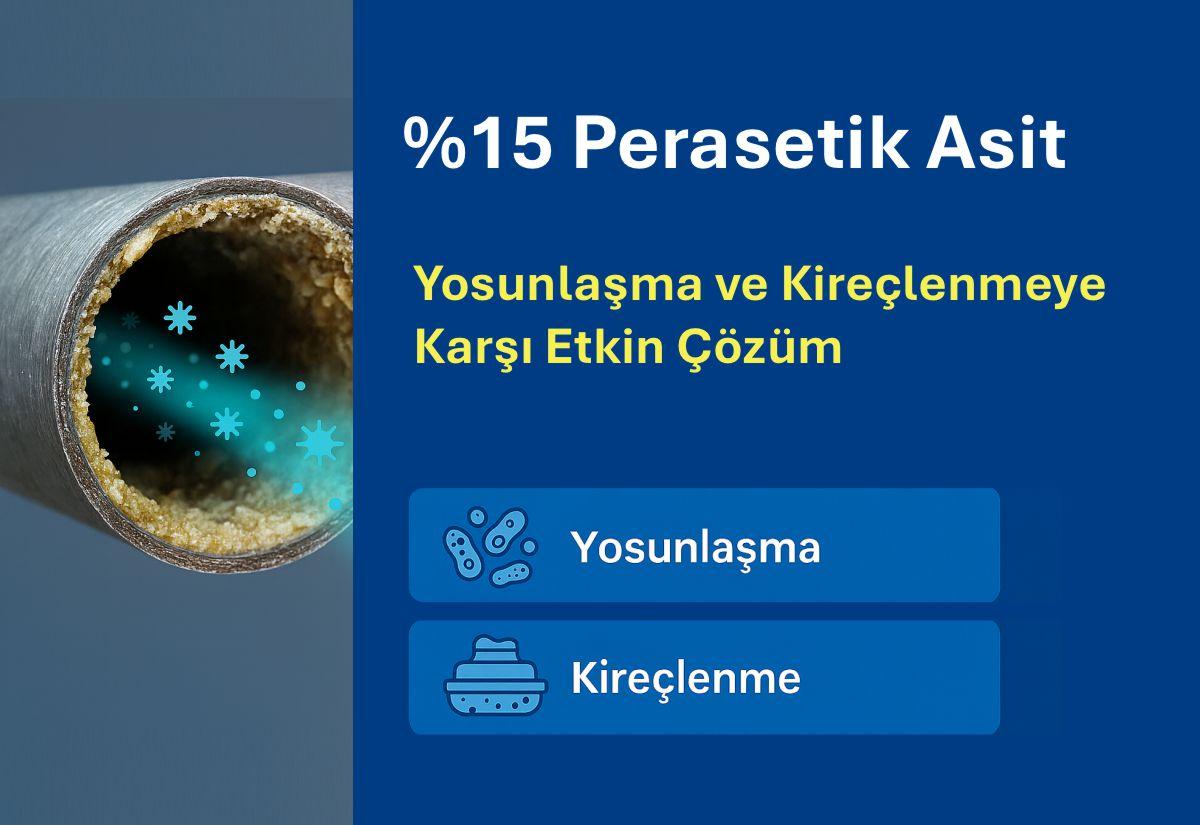
Biofilm (algae) and scaling problems in water pipes pose a significant risk to businesses. Learn more about biofilm control, indirect scaling prevention, and hygiene with 15% peracetic acid.
Son Güncelleme: 27 Eylül 2025 , Cumartesi
1. Introduction
One of the most common technical problems encountered in water-using businesses is algae (biofilm formation) and scaling (inorganic sediment accumulation), which develop over time in pipelines. These two conditions are natural processes resulting from the physical and chemical properties of water; however, if left uncontrolled, they not only degrade water quality, shorten equipment lifespan, and increase operating costs.
A biofilm layer forms when a sticky organic matrix produced by microorganisms adheres to the pipe surface. This layer thickens over time, reducing water flow and creating a favorable habitat for pathogenic microorganisms. Scale formation occurs as a result of the precipitation of calcium and magnesium salts (especially CaCO₃) in water. These crystalline structures, which adhere to surfaces, reduce heat transfer and cause constrictions and blockages in pipelines.
One of the most effective solutions used today to combat these two problems is the use of peracetic acid (PAA). Concentrated 15% PAA solutions, in particular, produce powerful effects when diluted at appropriate doses and introduced into water circuits. It suppresses biofilm through its oxidizing effect, indirectly preventing limestone from adhering to the surface, and helps keep the system clean. Another significant advantage is that PAA rapidly decomposes in the environment, turning into harmless components such as water, oxygen, and biodegradable acetic acid.
In this article, we will examine the causes of algae and calcification in water pipes, the damage they cause to businesses, and the protective effect of using 15% PAA, based on scientific data.
2. Algae (Biofilm) and the Formation of Scale
The algae observed in water pipes is actually a microbial process. Water transported through pipelines always contains microorganisms. These organisms attach to pipe surfaces and, over time, form a thin, slippery layer called a biofilm. Biofilm consists not only of algae but also of organic matrix secreted by bacteria, yeast, and other microorganisms. This layer can grow as visible greenish or brownish layers within the pipe.
Scaling, on the other hand, is a completely inorganic process. Calcium (Ca₃⁺) and magnesium (Mg₃⁺) ions dissolved in water combine with carbonate (CO₃⁻) and bicarbonate (HCO₃⁻) ions to form hard, crystalline structures like calcium carbonate (CaCO₃). These crystals accumulate on the pipe surface, particularly under high temperature and pH fluctuations. This thickening layer reveals itself as narrowed pipe cross-sections and blockages.
Although these two formation processes may seem different, they can actually support each other. The biofilm layer, the lime It provides an "adherence base" for the crystals. Similarly, limestone layers create rough surfaces for microorganisms to adhere to. Thus, biological and chemical contamination progress simultaneously, further complicating the problem.
How to tell?
A decrease in the flow rate of water passing through the pipe
Frequent filter blockages
Pressure Increased losses
Decreased efficiency in heat exchangers
Visual inspection reveals a slippery film or hard white/brown layers on the inner pipe surface
Therefore, both biofilm and scaling processes must be managed simultaneously in businesses.
3. Adverse Effects on Water Quality and Operations
Biofilm and calcification forming in water pipes not only affect the pipeline itself, but also cause serious adverse effects on the overall water quality, process efficiency, and hygiene standards of the operation.
1. Effects on Water Quality
Taste and Odor Problems: Microorganisms growing within biofilm can impart an unpleasant taste and odor to the water as a result of their metabolic activities.
Turbidity and Coloration: Detached biofilm fragments and lime crystals impair the water's clarity and create turbidity.
Microbiological Risk: Biofilm provides a suitable environment for pathogenic bacteria (e.g., Legionella, Pseudomonas). This poses a risk to both production processes and human health.
2. Effects on Operating Efficiency
Flow and Pressure Losses: Reducing the pipe cross-section reduces water flow rate and creates additional load on pump systems.
Increase in Energy Consumption: Especially when scale forms on heat exchanger surfaces, heat transfer decreases. More energy is consumed to reach the same temperature.
Shortening of Equipment Life: Scale and biofilm layers accelerate corrosion on pipe and equipment surfaces. This results in premature maintenance and replacement costs.
3. Impacts on Hygiene and Safety
Product Safety: Biofilm in water used in the food, beverage, textile, or pharmaceutical industries poses a direct threat to product safety.
Occupational Safety: Pressure losses and blockages can lead to system failures; sudden pipe bursts or process interruptions increase occupational safety risks.
Consequently Consequently, failure to prevent biofilm and scaling in a timely manner results in both visible costs (energy, maintenance, downtime) and invisible costs (product quality, customer confidence, hygiene risks).
4. The Role of PAA on Biofilm and Scale
Peracetic acid (PAA) is a powerful Thanks to its oxidant structure, it stands out as an effective disinfectant in both biological and chemical contamination processes. When applied to water systems with appropriate dilution, 15% concentrated solutions, in particular, make a significant contribution to keeping pipelines clean.
1. Effect on Biofilm
Oxidative Degradation: PAA destroys the cell walls of biofilm-forming microorganisms through oxidative destruction. This disrupts the biofilm's adhesion structure and breaks down the film.
Inhibiting New Film Formation: When PAA is continuously present at low levels in the system, it makes it difficult for microorganisms to reattach and rebuild the biofilm matrix.
Broad-Spectrum Effect: PAA is effective against bacteria, fungi, yeast, and algae. This broad spectrum of action provides protection against biological contamination from various sources.
2. Indirect Effect on Limescale
Preventing Surface Preparation: Biofilm provides a suitable substrate for lime crystals to adhere to. When PAA eliminates biofilm, it also reduces the surface conditions necessary for calcification to begin.
Slowing Accumulation: PAA does not directly dissolve limestone; however, it removes biological contaminants from the surface, thus slowing down the calcification process. The rate of thickening of the layers decreases.
Increasing Cleaning Effectiveness: PAA applications increase the effectiveness of lime solvents or antiscalants because the removal of the biofilm layer allows chemicals to penetrate the surface more easily.
3. Environmental Advantages
Fast Degradation: PAA decomposes into water, oxygen, and acetic acid. These by-products do not leave any lasting toxic effects on the environment.
Food and Beverage Safety: This feature allows for safe use, especially in the food, beverage, and textile industries.
5. Application Areas and Dosage Approaches
15% peracetic acid is a highly concentrated stock solution. In application, it should always be administered in a controlled manner.It is administered to the water system in dilute dosages. Correct dosage is critical for both biofilm suppression and indirectly preventing scaling.
1. Application Areas
Industrial Process Waters: Washing, rinsing, and transport water used in the textile, food, beverage, and chemical industries.
Cooling Water Systems: Prevention of biofilm formation in towers and circuits.
CIP (Clean-In-Place) Lines: Pipeline Ensuring hygiene on surfaces.
Water Storage Tanks and Distribution Lines: Preventing stagnation and reducing microbial load.
2. Dosage Approaches
Continuous Low Dose Application:
PAA is fed continuously at low levels to prevent biofilm formation in the facility.
Typical range: 2–5 mg/L active PAA
Purpose: To prevent the formation of new biofilm.
Intermittent Application:
PAA is fed at specific intervals.
Typical range: 2–9 mg/L
Purpose: To control biofilm formation through regular microbial suppression
Shock Cleaning (Disinfection) Application:
If biofilm or heavy contamination is present, high concentrations of PAA are applied.
Typical range: 50–150 mg/L active PAA, 4–8 hours contact
Purpose: To break down biofilm on surfaces and restore cleanliness to the circuit
3. Monitoring and Control
Online Parameters: PAA residue measurement, pH, temperature, conductivity
Microbiological Monitoring: Dipslide tests, ATP measurements, colonization coupons
Hydraulic Indicators: Flow rate, pressure losses, energy consumption trends
Limescale Trend Monitoring: Langelier Saturation Index (LSI), Ryznar Index
4. Important Note
Every facility's water quality is different. Therefore, the ideal dosage should be determined based on water hardness, temperature, organic load, and system design, while considering manufacturer recommendations and local regulations.
6. Effects on Water Softening and RO Systems
When used correctly, 15% peracetic acid can provide significant benefits in water softening and reverse osmosis (RO) systems, which are important links in the water treatment chain. However, incorrect dosage or uncontrolled use can pose risks, particularly in RO membranes.
1. Water Softening Systems
Biological Burden Reduction: PAA suppresses biological fouling, reducing the risk of biofilm-induced clogging of ion exchange resins.
Resin Efficiency: Clean water flow prevents microbial growth on the resin surface, increasing regeneration efficiency.
Synergistic Effect: PAA controls biological fouling, while antiscalant and softening systems chemically prevent scaling. Thus, both biological and inorganic pollution are simultaneously controlled.
2. RO (Reverse Osmosis) Systems
Biofilm Control: The greatest enemy of RO membranes is biofilm. PAA, when used in low concentrations, suppresses biofilm formation and extends membrane life.
Indirect Contribution to Scale: Pre-RO biofilm suppression contributes to the deposition of scale on the membrane surface. and reduces particle retention.
Risk Factors: RO membranes are generally polyamide-based and sensitive to oxidants. While PAA is considered more tolerant than chlorine, it can damage the membrane structure at high concentrations or with prolonged contact.
Manufacturer's Recommendation: The RO membrane manufacturer's chemical compatibility guidelines should be strictly observed. Controlled "car cleaning" applications are generally recommended over continuous dosing.
3. General Assessment
SRO softening + PAA: When used in conjunction, the system remains biologically and chemically clean.
RO + PAA: Only effective when applied at a controlled, low dose. High doses or incorrect application can shorten membrane life.
7. Material Compatibility and Safety
Because 15% peracetic acid (PAA) has a high oxidative power, its interaction with system materials must be taken into account. Correct material selection will both extend the life of the pipelines and It both prolongs life and provides a safe working environment in the plant.
1. Material Compatibility
Durable Materials:
Stainless steel (304, 316): is one of the most widely used metals against PAA. Grade 316, in particular, is resistant to chlorinated They are also more durable in harsh environments.
Plastics: Polyethylene (PE), polypropylene (PP), PTFE (Teflon), PVDF, and some fluoropolymers show high resistance to PAA.
Elastomers: EPDM and Viton are commonly preferred gasket materials in PAA applications.
Risky Materials:
Galvanized Steel and Iron: May corrode rapidly when in contact with PAA.
Copper and Brass (Brass): Surface deterioration and discoloration may occur due to oxidative effects.
Soft Steel: The risk of corrosion is high with prolonged contact.
2. Safe Handling and Storage
Concentrated Solution: 15% PAA is classified as a corrosive and strong oxidant. It should not be used directly without dilution.
Personal Protection: Gloves, safety glasses, and adequate ventilation are essential. Vapors should not be breathed, and skin contact should be avoided.
Storage: Store in compatible plastic drums in cool, dark, well-ventilated areas. Protect from heat and sunlight.
Mixture Compatibility: PAA should never be brought into direct contact with alkaline chemicals, reducing agents (e.g., sodium bisulfite), or heavy metal salts.
3. Operational Safety
Leaks: PAA is easily detected by its characteristic, pungent vinegar odor. This is a warning sign; however, excessive exposure is dangerous for employees.
Dosing Equipment: Corrosion-resistant pumps and lines should be preferred, and regular maintenance should be performed.
8. Conclusion and Recommendations
Algae growth (biofilm) and calcification in water pipes are two of the most common and costly problems businesses face. These problems not only reduce water quality but also shorten equipment lifespans, increase energy consumption, and thus increase operating costs.
15% peracetic acid (PAA), when applied with the correct dilution and controlled dosage:
It breaks down biofilm and prevents its re-formation.
It indirectly reduces scaling because When the biofilm layer is removed, the surface conditions on which crystals can adhere are also eliminated.
It synergizes with water softening and antiscalant applications, thus controlling both biological and chemical contamination simultaneously.
It is environmentally friendly because, when broken down, it breaks down into harmless products such as water, oxygen, and biodegradable acetic acid.
However, PAA alone is not a lime-dissolving agent. It should be noted that it is not a biofilm, that it can cause material corrosion at high doses, and that caution should be exercised, especially when used with RO membranes.
Recommendations for Businesses
Prevent biofilm formation from the outset with continuous low-dose application.
Break existing layers by shock dosing when necessary.
Be sure to integrate water softening and antiscalant systems; PAA's effect on scaling is complete.It is a hazardous substance.
Regularly monitor dosage and residue measurements and manage your system according to scientific parameters.
Pay attention to material compatibility; do not use PAA on incompatible metals and equipment.
For employee safety, do not neglect personal protective equipment during storage and use.
Consequently, 15% peracetic acid; When used with the right methods, it offers an effective, safe and environmentally friendly solution against biofilm and scaling in water systems.