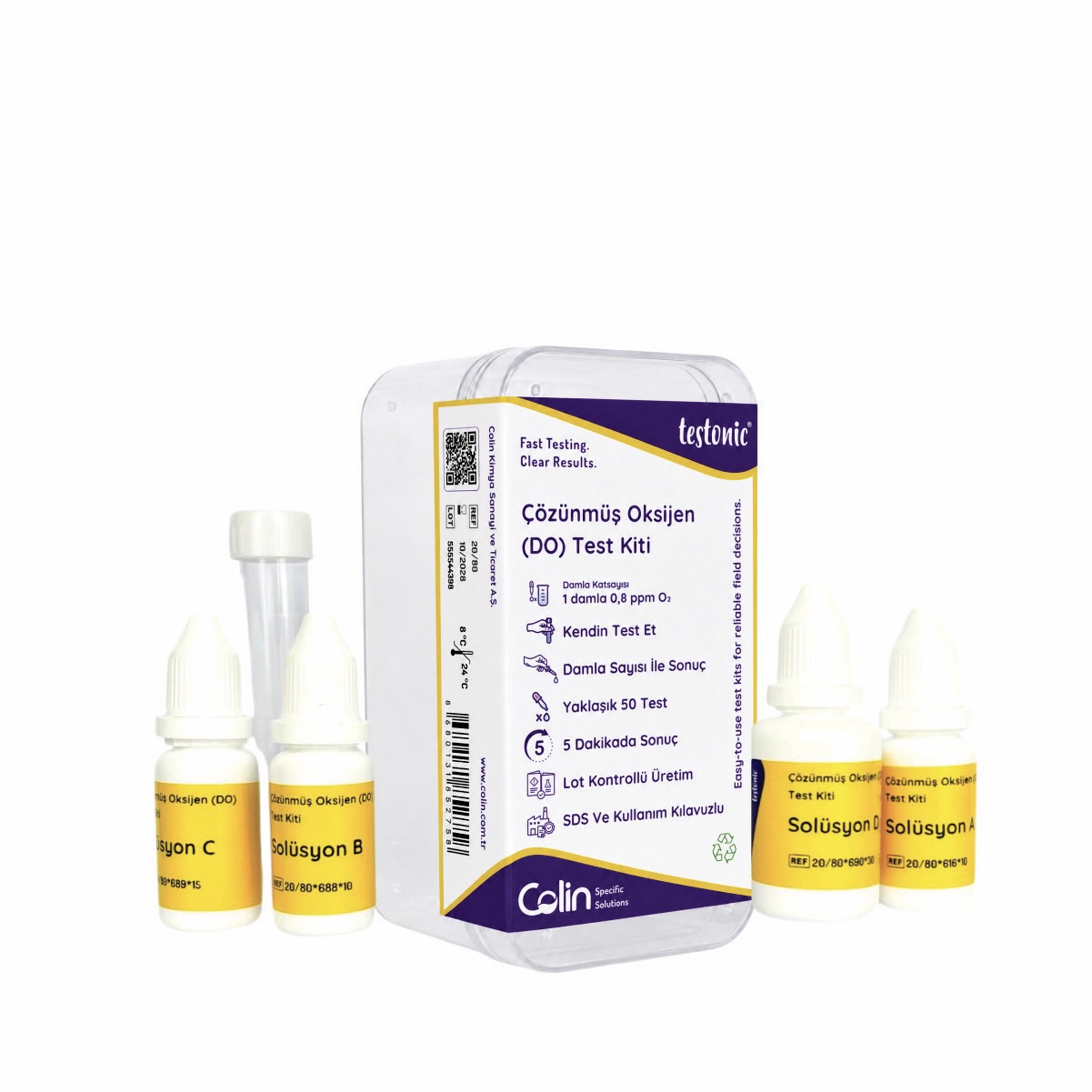
Testonic Dissolved Oxygen (DO) Test Kit is designed to determine the concentration of oxygen dissolved in water samples under field or laboratory conditions.
The result is calculated directly in mg/L O2 (ppm) from the number of drops required to reach the visual titration endpoint. Its instrument-free format facilitates routine dissolved oxygen monitoring in process water, environmental water samples, wastewater applications and aquaculture systems.
What Does It Measure and Why Is It Important?
Dissolved oxygen is the concentration of molecular oxygen present in water. It is a fundamental monitoring parameter used to assess water quality, biological activity, aeration conditions and the performance of many water-treatment processes.
The Testonic Dissolved Oxygen Test Kit determines the dissolved oxygen concentration present at the time of sampling through a drop-count measurement. The result should be evaluated against the target value specified for the relevant process or application.
Main Applications
- Industrial process-water monitoring
- Wastewater treatment and aeration applications
- Surface-water and environmental water samples
- Aquaculture and fish-farming systems
- Aquarium water-quality monitoring
- Inlet and outlet monitoring of water-treatment processes
- Routine field and laboratory water analysis
How Is the Result Obtained?
- Collect the water sample without forming air bubbles or exposing it to unnecessary aeration.
- Prepare the sample without delay, using the volume and sequence specified in the current instructions for use supplied with the product.
- Titrate the prepared sample one drop at a time to the visual endpoint, mixing carefully after each drop.
- Record the total number of drops used when the color disappears completely and the sample first remains colorless.
- Multiply the number of drops by 0.8 to calculate the dissolved oxygen result in mg/L O2.
Essential Technical Information
| Measured parameter | Dissolved oxygen (DO) |
| Suitable samples | Water and compatible aqueous process samples |
| Result unit | mg/L O2 (ppm) |
| Result format | Numerical result based on visual endpoint and drop count |
| Drop equivalence | 1 drop = 0.8 mg/L O2 |
| Approximate result time | 5 minutes |
| Approximate test capacity | 50 tests |
| Storage | Store in the original packaging with the caps closed, in a dry place away from direct sunlight. Do not freeze. |
Approximate test capacity may vary depending on the dissolved oxygen concentration in the sample and the amount of titration solution consumed in each analysis.
Interpretation of Results
| Result or observation | Interpretation |
|---|---|
| Titration solution is consumed before the visual endpoint is reached | This indicates a measurable dissolved oxygen concentration in the sample. Calculate the result as the total number of drops × 0.8. |
| Higher drop count | Corresponds to a higher dissolved oxygen concentration. The suitability of the result should be evaluated against the target value for the relevant process or water type. |
| Very low titrant consumption | The dissolved oxygen concentration may be close to or below the kit’s drop-based resolution. This should not be interpreted as proof of the complete absence of oxygen. |
| Unclear or unstable endpoint | Do not report the result. Check the sampling and application conditions and repeat the analysis using a fresh sample. |
- Rinse the sample container with the water and fill it without leaving air bubbles.
- Do not shake, aerate or pour the sample from height into another container.
- Close the container without delay after preparing the sample.
- Use the sample volume and measuring equipment specified in the product instructions.
- Do not allow dropper tips to contact the sample or interchange caps between bottles.
- Hold the bottle vertically, allow each drop to form completely and proceed slowly as the endpoint approaches.
- Strongly colored or highly turbid samples, as well as samples containing strong oxidizing or reducing substances, may affect the result.
Storage, Safety and Technical Support
Store the product in its original packaging with the caps tightly closed, in a dry place away from direct sunlight. Do not freeze the reagents or use products that have passed their expiry date or show an unexpected change in appearance.
The kit contains chemical reagents. Wear safety glasses and suitable chemical-resistant gloves during testing, and avoid contact with the skin and eyes. Do not discharge used reagents into drainage systems without appropriate control. Dispose of waste in accordance with the SDS and applicable local regulations.
Perform the analysis according to the current instructions for use supplied with the product and consult the SDS for detailed safety information. Colin technical support is available to assist with special samples, process conditions and interpretation of results.
Technical Documents
Related Posts
Related News
Technical Support and Product Consulting
You can use the form to find the most suitable chemical solution for your needs or to obtain detailed information about the technical specifications of our products.
Your requests are carefully reviewed and answered by Colin's expert team.
You can ask us about the product.