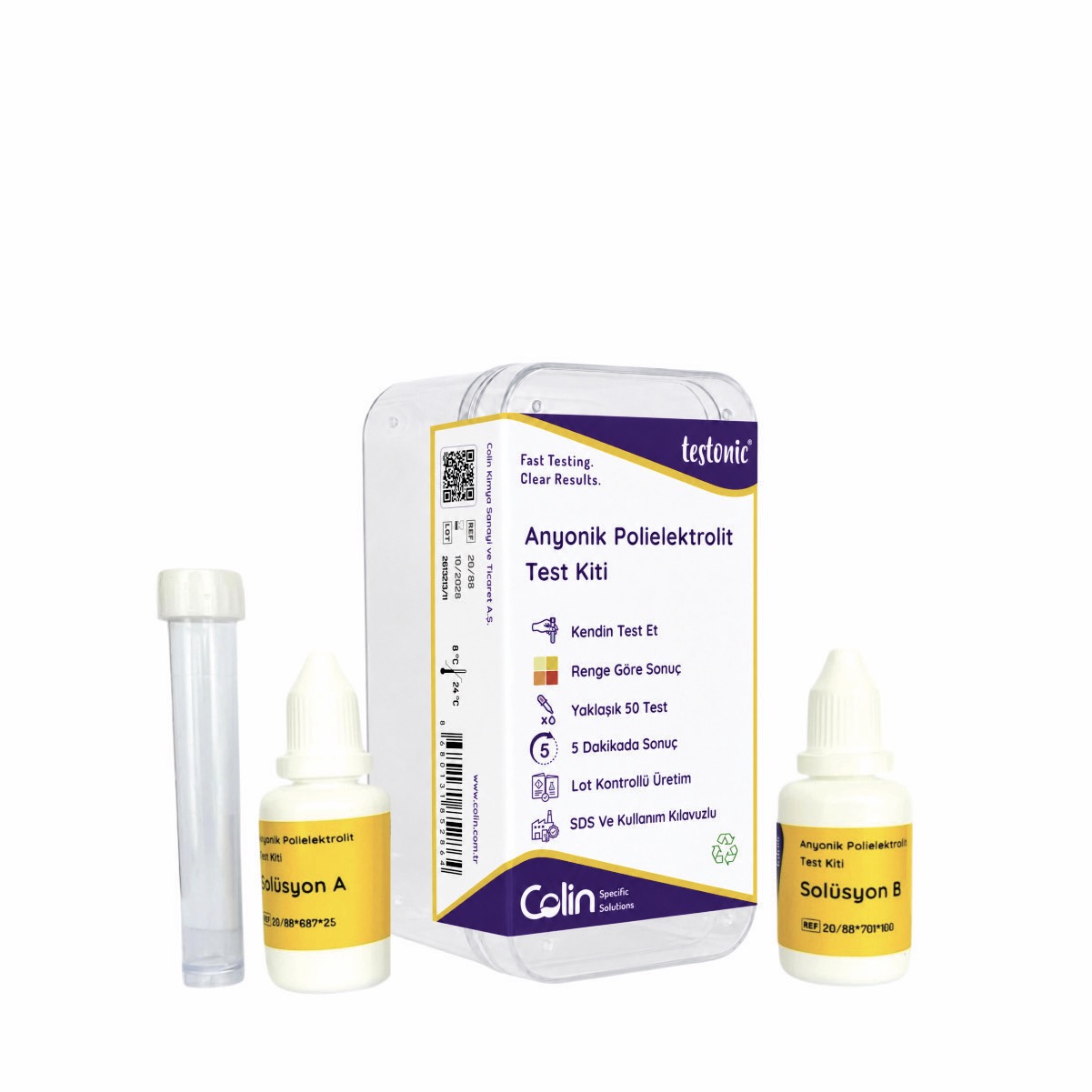
Anionic Polyelectrolyte Test Kit

Detect anionic polymer traces in brine and process water. Ensure dyeing consistency and prevent gelling risks in storage tanks effectively.

  • Rapid result test format
  • Practical field-use analysis
  • No additional equipment required
  • High repeatability
  • Minimum 50 tests per kit
Providing details like intended use, delivery location, packaging preference, and quantity will help us offer you faster and more accurate pricing.
Product Code: 286
Barcode: 8680131852864
Last update: 13 Temmuz 2026 , Pazartesi

Quick and Reliable Detection of Polymer Residues in Industrial Water

Anionic polyelectrolytes, used in water treatment processes, are high molecular weight polymers widely used for the removal of suspended solids and the improvement of filtration performance.

These flocculants are used in many sectors, including drinking water treatment, industrial process water, food production, chemical plants, and textile dyeing facilities.

However, in some cases, trace amounts of polymer residues may be found in process water or raw materials. These residues are usually not directly noticeable; However, in some applications:

  • May affect filtration performance

  • May form a film layer on surfaces

  • May alter process stability

  • May cause viscous deposits in equipment or storage systems

The Anionic Polyelectrolyte Test Kit has been developed to detect anionic polyelectrolyte residues in water and liquid raw materials with a rapid field test.

The test is completed quickly using a few drops of reagent.

It provides and requires no laboratory equipment.


This allows potential polymer-related risks in process water or raw materials to be controlled at an early stage.


Test Principle

The Anionic Polyelectrolyte Test Kit is based on a specific complexation reaction targeting the electrical charge properties of anionic polymers.

The reactants added to the sample interact with the anionic polymer chains, causing:

  • color change

  • turbidity

  • fibrous floc formation

visible reactions such as It forms.

These reactions indicate the presence of anionic polyelectrolyte residue in the sample.


The test result can usually be observed within 30–60 seconds.


Applications

The Anionic Polyelectrolyte Test Kit can be used in the following areas:


  • Industrial water treatment systems

  • Process water quality control

  • Flocusant dosage optimization

  • Filtration and membrane systems

  • Chemical production plants

  • Food and beverage process waters

  • Textile dyeing and finishing plants


Outstanding Features

  • High sensitivity to anionic polymers

  • Fast field analysis (≈1 minute)

  • Simple application – No device required

  • Reaction system providing visual verification

  • Reliable results in different water matrices


Special Information for Textile Dyeing Plants

In the textile sector, salt solutions and process waters are critical parameters that directly affect dyeing quality.

Especially in reactive dyeing processes, high-concentration salt solutions (brine) undergo various treatment processes during production or refining stages.

can pass.


Some manufacturers use the following in these purification processes:

  • PAC (Polyaluminum chloride)

  • Anionic polyelectrolytes

removes suspended solids from salt using these methods.

Under normal conditions, these chemicals are separated from the system by sedimentation.

However, in rare cases, trace amounts of polymer residue may be carried along with the liquid salt.


These residues may, in some cases:


  • contribute to the formation of viscous sediments in storage tanks

  • affect filtration systems

  • alter dye penetration by adsorbing to the fiber surface in the dye bath

These effects can often occur even at very low concentrations, making detection difficult.

The Anionic Polyelectrolyte Test Kit allows for quick testing of liquid salt shipments or process water. It reveals the presence of possible polymer residues within seconds.


Thus, dye houses:

  • can control the quality of incoming liquid salt

  • treatment systemsYou can monitor the polymer dosage in the process.

  • You can evaluate potential quality problems in dyeing processes in advance.


Frequently Asked Questions

Do polyelectrolyte residues always cause problems?

No. In most cases, the concentrations are very low, so there is no direct problem. However, in some sensitive processes, even trace amounts can change the process behavior. Therefore, measurement is recommended for quality control purposes.


What types of polymers does the test detect?

The Anionic Polyelectrolyte Test Kit is specifically designed to detect flocculant polymers carrying an anionic charge.


Does the test require a laboratory?

No. The test can be performed in the field with a few drops of reagent, and the results are evaluated visually.

Test and Process Control Kits for Textile Finishing and Dyeing Mills

Checks anionic polyelectrolyte traces in brine, process water or treatment lines, supporting monitoring of flocculation, gelling and carryover risks.

Technical Documents

No technical document has been added for this product yet.
Related Posts

Related News

Technical Support and Product Consulting

You can use the form to find the most suitable chemical solution for your needs or to obtain detailed information about the technical specifications of our products.
Your requests are carefully reviewed and answered by Colin's expert team.

You can ask us about the product.

Colin Chemical Industry Inc.
We have been offering specific solutions for your scientific preferences for 26 years.

İkitelli OSB Mutsan Sanayi Sitesi M10 Blok No:3 Başakşehir İSTANBUL


© 2026 Colin Kimya San. ve Tic. A.Ş. All Rights Reserved. 18.97.9.168